UNIT
I
1. What is the number of swaps required to sort n elements using selection
sort, in the worst case?
1M
(A) O(n)
O(n)
(B) O(n log n)
(C) O (n^2 )
(D) O (n^2 log n)
(A)
O(n)(B)
O(n log n)(C)
O (n^2 )(D)
O (n^2 log n)
2.
Which of the following sorting algorithms has the
lowest worst-case complexity?
1M
(A) Merge sort
(B) Bubble sort
(C) Quick sort
(D) Selection sort
(A) Merge sort
(B) Bubble sort
(C) Quick sort
(D) Selection sort
3. Which one of the following in place
sorting algorithms needs the minimum number of swaps?
1M
(A) Quick sort
(B) Insertion sort
(C) Selection sort
(D) Heap sort
(A) Quick sort
(B) Insertion sort
(C) Selection sort
(D) Heap sort
4. ______________ is an operator in C++.
a) else b) case c) delete d) TRUE
5.
How many passes will be performed in radix/bucket sort if ‘n’
numbers are present?
1M
a.
N b.n-1 C. number of digits present in
largest number of given number. D. None of the above.
6. __________ is not a Software
development cycle activity.
a) Coding
b) Workflow
c) Requirement analysis
d) Testing
7. -----
is he operation to be evaluated first in
following expression. A+B*C/--B^4
a)
B^4 b) -
- B c) B*C d)- -B^4
8. Two
main measures for the efficiency of an algorithm are a. Processor and
memory
-1M
a. Complexity and
capacity b. Time
and space c. Data and space D. none of these
9.
What is the worst-case time for merge sort to sort an array of n
elements?
-
1M
a.
O(log n)
b.
O(n)
c.
O(n log n)
d.
O(n²)
10. The
time complexity of Bubble sort algorithm is 1M
a.
O(n) b. O(log n) c. O(n2) d. O(n log n)
11. The
best case time complexity of merge sort algorithm is 1M
a.
O(n) b. O(log n) c. O(n2) d. O(n log n)
12.
State
whether the function is true or false: 10n2 +
4n + 2 = O(n2) 1M
A) True B) False
C) can’t say D) none of these
13.
The
datatype for “87654” is 1M
a) integer b)char c)string d)real
14.
The Software development cycle will not
include 1M
a) Coding b) Search c) Analysis
d) Testing
15.
External sorting method is
1M
a) Merge
sort b) Quick sort
c) Radix sort d) Exchange sort
16.
The best case
time complexity of internal
sorting is 1M
a)O(n) b) O(n log n) c)
O(n2) d) O(log n)
17.
) The
quick sort uses the approach of 1M
i) divide and solve ii) divide
and conquer
iii) merging iv)
increments
18.
Radix sort uses 1M
a) bucket sort
b) insertion sort
c) selection sort
d) MSD sort
19.
The
datatype for 2.45E6 is
1M
a) integer b)char c)string d)real
20.
The
non stable sorting algorithm is 1M
a) quicksort b) merge sort c) makesort d)
insertion sort
21.
The
value of 5MOD 355 is 1M
a) 0 b)3 c)5 d)55
22.
The
non stable sorting algorithm is
1M
a) quicksort
b) merge sort c) makesort d)
insertion sort
23.
What is wrong if LN is the identifier
for last name? 1M
a) It has only 2 characters b) The first letter is capital
c) Is not valid
d) Inconsistent name
24) The first pass of
quick sort divides the list in to 1M
a) 2 sorted lists
b) 2
unsorted lists
c) 2 sorted elements
d) 2 merged lists
25) The
worst case time complexity of merge sort is 1M
a)O(log n) b) O(n) c)
O(n2) d) O(n log
n)
26)
_________ requires additional space for sorting. 1M
a) quicksort b)shell
sort
c) merge
sort d) radix sort
27) In place
sort uses
1M
a) a temporary list b)
an extra list
c) original list d) merged list
28) The
parallelogram in flowchart stands for 1M
a)
input/output b) function
c) flow d)
module
29.
The
internal documentation can be 1M
Help file b) Manual
c)
Comments d) Search
30. What
is the worst-case time for quicksort to sort an array of n elements? 2M
a.
O(log n)
b.
O(n)
c.
O(n log n)
d.
O(n²)
31. Merge
sort makes two recursive calls. Which statement is true after these recursive
calls finish, but before the merge step?
2M
a.
The array elements form a heap.
b.
Elements in each half of the array are sorted amongst themselves.
c.
Elements in the first half of the array are less than or equal to
elements in the second half of the array.
d.
None of the above.
32. Suppose
we are sorting an array of eight integers using quick sort, and we have just
finished the first partitioning with the array looking like this: 2M
2
5 1 7
9 12 11 10
Which statement is correct?
a.
A. The pivot could be either the 7 or the 9.
b.
B. The pivot could be the 7, but it is not the 9.
c.
C. The pivot is not the 7, but it could be the 9.
d.
D. Neither the 7 nor the 9 is the pivot.
33. What
is the worst-case time for heapsort to sort an array of n elements? 2M
a.
A. O(log n)
b.
B. O(n)
c.
C. O(n log n)
d.
D. O(n²)
34. Here
is an array of ten integers:
2M
5, 3, 8, 9, 1,
7, 0, 2, 6 4 Draw
this array after the FIRST pass of the shell sort (sorting from smallest to
largest by considering span for first iteration n/2).
a.5,0,8,6,1,7,3,2,9,4
b.5,0,2,6,1,7,3,8,9,4
c.5,0,2,9,1,7,3,8,6,4
d.5,3,8,6,1,7,0,2,9,4
35. In a
bubble sort of n elements, how many times is the swap function called in the
complete execution of the algorithm? 2M
a.
A. 1
b.
B. n - 1
c.
C. n log n
d.
D. n²
36. Selection
sort and quick sort both fall into the same category of sorting algorithms.
What is this category?
2M
a.
A. O(n log n) sorts
b.
B. Divide-and-conquer sorts
c.
C. Interchange sorts
d.
D. Average time is quadratic.
37. Suppose
that a selection sort of 100 items has completed 42 iterations of the main
loop. How many items are now guaranteed to be in their final spot (never to be
moved again)? 4M
a.
A. 21
b.
B. 41
c.
C. 42
d.
D. 43
38. The time complexity of shell sort is
2M
a.
n2 b.n(logn) c. n(log n)2 d.n3
39. Arrange following from lowest to highest order
by complexity wise 2M
I log n II. n!
III. nlogn IV. n2
A. I,II,III,IV B. II, III,I ,IV C I, III,IV,II D. II, I, IV, III
40. Arrange
following from highest to lowest order by complexity wise 2M
I log n II. n!
III. nlogn IV. n2
A. I,II,III,IV B. II, III,I ,IV C I, III,IV,II D. II, IV, III, I
41. Suppose
that a bubble sort of 100 items has completed 42 iterations of the main loop.
How many items are now guaranteed to be in their final spot (never to be moved
again)?
2M
a.
A. 21
b.
B. 41
c.
C. 42
d.
D. 43
42. When
is insertion sort a good choice for sorting an array? 2M
a.
Each component of the array requires a large amount of memory.
b.
Each component of the array requires a small amount of memory.
c.
The array has only a few items out of place.
d.
The processor speed is fast.
43.
What is the complexity of T(n)=T(n/2) + 1 in
recursive manner? 2M
- O(log
n)
- O(n log n)
- O(n)
- O(n^2)
44.  The
time factor when determining the efficiency of algorithm is measured by
--
2M
a.
Counting microseconds b. Counting the number of key operations
The
time factor when determining the efficiency of algorithm is measured by
--
2M
a.
Counting microseconds b. Counting the number of key operations
The
time factor when determining the efficiency of algorithm is measured by
--
2M
a.
Counting microseconds b. Counting the number of key operations
c. Counting the number of
statements d. Counting the kilobytes
of algorithm
45. The
space factor when determining the efficiency of algorithm is measured by 2M
a.
Counting the maximum memory needed by the algorithm
b. Counting the minimum memory needed by the
algorithm
c. Counting the average memory needed by the
algorithm
d. Counting the maximum disk space needed by
the algorithm
46. What
will be the output after first pass of the quick sort for sorting in ascending
order by considering first element as pivot element for following data? 2M
8,5,3,2,9,7,12,15
a. 5,3,7,2,8,9,12,15
b.7, 5,3, 2,8,9,12,15
c.8,5,3,2,7,9,12,15
d.12,15,9,7,2,3,8,5
47. If
the following is the list to be sorted by
radix sort, which bin will have the most number of elements from the
list in first pass?
150,270,989,83,97,234, 334, 535,
457, 527,539,667
a) 1
b) 0
c) 5
d)7
a.
The
value of the expression (A-B) *C+D/A is
_____ for A=2, B=4, C=2,D=4
a) -2 b)-4 c)
2 d) 6
b.
The
expression for the discount of 10% for general product and 40% for books is
given by
a) discount= 10/100 *price_book
b) discount= 40/100*book_price
c) discount = 40/100*price_generalproduct
d)
discount=book_price-40/100*book_price
c.
=
stands for __________ operator in the expression, X+C=B+C and its value if
X=C=8 and B=4
a)
assignment,12
b) relational, FALSE
c) logical, FALSE
d) assignment,0
6) The first pass of shell sort will give the
result as (with increment 3) _______for the list 17,34, 56,10,78,45,8
a) 10, 17,34,56,78,45,8
b)8,34,45,10,78,56,17
c)8,34,56,10,78,45,17
d)8,34,56,17,78,45,10
7) The order of evaluation for the expression
A*B/C-D+B<A is
a)
*,/,-,+,<
b) *,/,<,-,+
c) *,/,+,<,-
d) /,*,<,-,+,<
8) The
merging for the non recursive merge sort
for pass2 is
a) merging of lists of size 1
b) merging
of lists of size 2
c) merging of 2 lists of size 2
d) merging 1 list of size 2
9) The appropriate modules in a structure chart
‘to search for a odd number in a list of
numbers’ can be
a) Read, search, check_even, display
b) Read_list, check_odd, display
c)Read_list, search, display
d) )
Read_list, search, check_odd, display
10) The
value of expression in C++ for the following expression
x+y*--x/z-- for
x=1, y=5, z=9 is
a) 1
b)0.1
c)0
d)1.1
11)
The expression for the x+y(7+z) is
--------
x-y
a)x+y*7+z/x-y
b)x+y*(7+z)/x-y)
c)x+y*(7+z)/(x-y)
d)
(x+y)*(7+z)/x-y)
12) The following relational expression evaluates to
be____ for x=2, y=9,z=1
if(x<y and z==1)
z++;
47.Suppose we are sorting an
array of eight integers using heap sort, and we have just finished one of the
reheapifications downward. The array now looks like this: 6
4 5 1
2 7 8
How many reheapifications
downward have been performed so far?
4M
a.
A. 1
b.
B. 2
c.
C. 3 or 4
d.
D. 5 or 6
48. What
is the output of following
4*5 -2/(3+3)*9
a.
20 b.
27. c .81 d.1/3
49. Which of the following are stable sorting
methods
a.
bubble b. Quick
c. Merge
A. a & b B. b & c C. a & c D. a, b & c
50. Which
of the following are not stable sorting methods
a.
bubble b. Quick
c. Merge
A. a
& b B. b & c C. Only b D. Only a
51. Which
of the following are stable sorting methods
a.
merge b. Quick
c. radix
A. a
& b B. Only a C.
Only c D. Only b
52. Which
of the following are not stable sorting methods
a.
merge b. Quick
c. radix
A. a
& b B. Only b C.
B& c D. Only c
53. PAC shows
a.
end of problem
b.
layout of solution
c.
beginning of analysis of problem
d.
All above
54. Structure/Iteractivity chart shows
a.
end of problem
b.
overall layout of solution
c.
beginning of analysis of problem
d.
All above
55. While
solving a problem with computers the term 'solution' means
ñ outcome
ñ result
ñ Set
of instructions
ñ all
of above
56.
______________
is an operator.
a) if b) case c) new d) TRUE
57. While
solving a problem with computers the term 'Result' means
ñ outcome
ñ solution
ñ Set
of instructions
ñ all
of above
58.
___________ is the first step in Software Development
Cycle.
a) Analysis b) Design c) Testing d)
Modeling
59.
if x is float variable, y is integer variable,what is correct way of
getting integer part of x in y?
a. Not possible
b. can't say
c. y = (int)x
d. y = x.int();
60.
_____________
is the operation to be evaluated first in following expression.
A+B*C/B^4
a) B^4 b) A+ B c) B*C d)
C/B
61.
random() is what type of function
a. statistical
b. mathematical
c. utility
d. conversion
62.
_____________
is the operation to be evaluated first in following expression.
B*C%B^4
a) B^4 b) C% B c) B*C d)
all have same priority
63.
Which
of the following has equal priority in expression <, <=, > , >=
a. <,>
b. <=,>=
c. <,<=,>,>=
d. <,>=
64.
_______ are small sets of instructions that perform specific tasks
and return values.
1. Functions
2. Algorithm
3. Expression
4. Equation
65.
______ are combined with constants and variables to create
expressions and equations.
(I)Operands
(II)Data types (III)Operators
a. All
b. I and III
c. III only
d. II only
66.
The
tic tac toe problem has algorithmic
solution.
a)True b)False c)Can not say d) always
67.
Which
of the following steps of problem solving can be implemented by computer.
1. Selecting best of the alternatives
2. Understanding the problem
3. Writing instructions
4. Evaluating the solution
68.
The three constructs that can be used in
algorithm are
1. Sequence, loop, iteration
2. Sequence, loop, block
3. Sequence , if, block
4. Sequence, iteration, decision
69.
The
balancing cheque book problem has algorithmic solution.
a)True b)False c)Can not say d) No, heuristic
70.
What represent the following two symbols
=, ==
a. equality,equality
b. assignment,equality
c. equality, assignment
d. assignment, assignment
71.
Variables
and constant can be of different data type.
a)True b)False c)Can not say d) No, fixed
72.
“XX98”
is a ___________ constant.
Interger b) Char c) String c) hex
73.
Data
set of natural numbers can be
1. All Numbers >0
2. All whole numbers
3. All rational numbers
4. All whole and decimal numbers
74.
The
variable name , Hours-worked_for gives
error because
1. It has operator –
2. It exceeds length
3. It starts with capital alphabet
4. It has character _
75.
Logical
data types can not have values of
1. TRUE or FALSE
2. Y or N
3. 0 or >0
4. Yes or No
76.
Data
set of real numbers can be
1. All Numbers >0
2. All whole numbers
3. All rational numbers
4. All whole and decimal numbers
77.
Data
type for Date can be i)integer ii)float
iii)string
1. i only
2. ii only
3. iii only
4. i or ii only
78.
Data
files are stored in
1. External storage
2. Internal memory
3. Variables
4. Constants
79.
Time()
function is
1. Mathematical function
2. Statistical function
3. Utility function
4. String function
80.
A+B
= C(A-D) is equivalent to ________ statement.
----------
Y
1. A=C*(A-D ) /Y
2. B=C(A-D)/Y-B
3. A=C*(A-D)/Y-B
4. B=((C*(A-D))/Y)-A
81.
___________ can be used to represent the algorithm.
1. Problem analysis chart
2. Pseudocode
3. Structure chart
4. Interactivity chart
82.
Set up a logical expression to check data using the following
criteria. The data is assumed to be correct when:
a. Number is <1000
b. Number is positive
c. Number is divisible by 2
(a)
(N<1000)&&(N>0)&&(N MOD 2)
(b) (N<1000)||(N>0)||(N
MOD 2)
(c )
(N<1000)&&(N>0)&&NOT(N MOD 2)
(d) (N<1000)||(N>0) ||NOT(N MOD 2)
83.
Suppose
you are given an array s[1...n] and a procedure reverse (s,i,j) which reverses
the order of elements in a between positions i and j (both inclusive). What
does the following sequence
do, where 1 < k <= n:
reverse (s, 1, k);
reverse (s, k + 1, n);
reverse (s, 1, n);
(a) Rotates s left by k positions
(b) Leaves s unchanged
(c) Reverses all elements of s
(d) None of the above
84.
Which
of the given options provides the increasing order of asymptotic complexity of
functions f1, f2, f3 and f4?
f1(n) = 2^n
f2(n) = n^(3/2)
f3(n) = nLogn
f4(n) = n^(Logn)
A) f3, f2, f4, f1f1(n) = 2^n
f2(n) = n^(3/2)
f3(n) = nLogn
f4(n) = n^(Logn)
B) f3, f2, f1, f4
C) f2, f3, f1, f4
D) f2, f3, f4, f1
85.
What is
frequency count of the following code
float avg(int a[10],int n)
{
int s = 0;
flaot avg;
for(int i=1;i<=n;i++)
s+=a[i];
avg = s/n;
return(avg);
}
a.2n
b.2n+2
c.2n+3
d.2n+4
·
27. Explain the Asymptotic notations with example
- Omega, Theta 4M
27. Explain the Asymptotic notations with example
- Omega, Theta 4M
·
28. Explain the Asymptotic
notations with example - Omega,
Sigma 4M
·
29. Explain the Asymptotic
notations with example - Theta,
Sigma 4M
·
Write an algorithm for Quick Sort. Also explain its time
complexity for best case, worst case & average case. --- 8M
·
Write an algorithm for Merge Sort algorithm. Draw the tree
structure of the recursive calls made.
---8M
·
Describe a case where quicksort will result in quadratic
behavior. 8M
·
Here is an array apply
quicksort on it & show step by step output. ---8M
§ 3, 0, 2, 4, 5,
8, 7, 6, 9
·
Write an algorithm for to describe a heapsort & explain with
example -8M
·
Fill in the following table for the times to sort an array of n
items. Use only big-O notation, and do not have any extraneous constants in
your expressions.
|
|
|
|
|
|
|
|
|
|
|
|
|
|
|
|
|
|
|
|
|
|
|
|
|
|
·
Suppose that you implement quicksort nonrecursively using a stack,
as in your last programming assignment. You use your algorithm to sort an array
of 100 items, and at the start of the final iteration of the while loop, the
stack contains just two numbers: 10 (on top) and 90 (on bottom). Write one or
two clear sentences to describe which parts of the array are sorted at this
point, and which parts of the array remain to be sorted.
UNIT II Binary Tree
1.
What are the maximum numbers of levels in a binary tree containing
n nodes?
1- M
a. N-1 b.
n+1 c. n d.
either a or c
2.
Which of the following data
structure is not linear data structure? 1M
a.
Arrays b. Linked lists c. Both of above d. None of
above
3.
Which of the following data structure is
linear data structure?
1M
a.
Trees b. Graphs
c. Arrays d. None of above
4.
What are the maximum number of nodes at level k in a binary tree? 1-M
a.2k-1 b 2k
c.2(k+1) d. none of these
|
Consider
This Tree for
Question Q3 to Q8
|
|
14
/
\
2
11
/ \
/ \
1
3 10 30
/
/
7 40
|
5.
There is a tree in the box at the top of this section. How many
leaves does it have? 1-M
o A. 2
o B. 4
o C. 6
o D. 8
o E. 9
6.
There is a tree in the box at the top of this section. How many of
the nodes have at least one sibling? 1-M
o A. 5
o B. 6
o C. 7
o D. 8
o E. 9
7.
There is a tree in the box at the top of this section. What is the
value stored in the parent node of the node containing 30? 1-M
o A.
10
o B. 11
o C.
14
o D.
40
o E.
None of the above
8.
There is a tree in the box at the top of this section. How many
descendants does the root have? 1-M
o A. 0
o B. 2
o C. 4
o D. 8
9.
There is a tree in the box at the top of this section. What is the
depth of the tree? 1-M
o A. 2
o B. 3
o C. 4
o D. 8
o E. 9
10. There
is a tree in the box at the top of this section. How many children does the
root have? 1-M
o A. 2
o B. 4
o C. 6
o D. 8
o E. 9
11. How
many nodes are in a full binary tree having k levels? 1-M
a.2k-1 b 2k c.2(k+1) d. none of these
12. A
binary tree in which if all its levels except possibly the last, have the
maximum number of nodes and all the nodes at the last level appear as far left
as possible, is known as
1-M
A. Full binary tree B.
AVL C. Threaded binary tree D. Complete binary tree
13. Consider
the binary_tree_node t. Which expression indicates that t represents an empty
tree? 1-M
o A. (t
== NULL)
o B.
(t->data( ) == 0)
o C.
(t->data( ) == NULL)
o D.
((t->left( ) == NULL) && (t->right(
) == NULL))
14. If a
node having two children is deleted from a binary tree, it is replaced by
it’s -
1M
o A.
inorder predecessor
o B.inorder
successor
o C. A
or B
o D.
none of the above
15. In a
binary tree, certain null entries are replaced by special pointers which point
to nodes higher in the tree for efficiency. These special pointers are
called A.
Leaf B. branch C. Path D.
Thread 1-M
16. The
depth of a complete binary tree is given by 1-M
o A.
Dn = n log2n
o B.
Dn = n log2n+1
o C.
Dn = log2n
o D. Dn =
log2n+1
17. The
number of leaf nodes in a complete binary tree of depth d is 1-M
o A. 2^d
o B.
2^(d+1) – 1
o C.
2^(d-1) – 1
o D.
2^d + 1.
18. What
are the maximum number of nodes in a binary tree containing k levels? -
2M
a.2k-1 b 2k c.2(k+1) d. none of these
19. How
many nodes are in a full binary tree with k levels? 2-M
a.2k-1 b 2k c.2(k+1) d. none of these
20. What
are the minimum possible number of levels in a binary tree of n nodes? -
2M
a. N b.n-1 c. floor(log2n)+1.
D.none of these
21. How
many different binary trees containing exactly n nodes are there? 2-M
a.
(2n)!/((n+1)!n!). b.2n
c. n! d. n(n+1)
22. Consider
the binary tree in the box at the top of this section. Which statement is
correct? 2-M
o A.
The tree is neither complete nor full.
o B.
The tree is complete but not full.
o C.
The tree is full but not complete.
o D.
The tree is both full and complete.
23. What
are the minimum number of nodes in a full binary tree with depth 3? 2-M
o A. 3
o B. 4
o C. 8
o D.
11
o E.
15
24. What
are the minimum number of nodes in a complete binary tree with depth 3?
2-M
o A. 3
o B. 4
o C. 8
o D.
11
o E.
15
25. Select
the one true statement.
2-M
o A.
Every binary tree is either complete or full.
o B.
Every complete binary tree is also a full binary tree.
o C. Every
full binary tree is also a complete binary tree.
o D.
No binary tree is both complete and full.
26. Suppose
T is a binary tree with 14 nodes. What is the minimum possible depth of T?
2-M
o A. 0
o B. 3
o C. 4
o D. 5
27. Select
the one FALSE statement about binary trees: 2-M
o A. Every
binary tree has at least one node.
o B.
Every non-empty tree has exactly one root node.
o C.
Every node has at most two children.
o D.
Every non-root node has exactly one parent.
|
|
28. Consider
the node of a complete binary tree whose value is stored in data[i] for an
array implementation. If this node has a right child, where will the right
child's value be stored? 2-M
o A.
data[i+1]
o B.
data[i+2]
o C.
data[2*i + 1]
o D.
data[2*i + 2]
|
|
29. Suppose
that a binary taxonomy tree includes 8 animals. What is the minimum number of
NONLEAF nodes in the tree? 2-M
o A. 1
o B. 3
o C. 5
o D. 7
o E. 8
|
|
|
14
/
\
2
11
/ \
/ \
1
3 10 30
/
/
7
40
|
30. There
is a tree in the box at the top of this section. What is the order of nodes
visited using a pre-order traversal? 2M
o A. 1
2 3 7 10 11 14 30 40
o B. 1
2 3 14 7 10 11 40 30
o C. 1
3 2 7 10 40 30 11 14
o D. 14 2
1 3 11 10 7 30 40
31. There
is a tree in the box at the top of this section. What is the order of nodes
visited using an in-order traversal?
2-M
o A. 1
2 3 7 10 11 14 30 40
o B. 1 2 3
14 7 10 11 40 30
o C. 1
3 2 7 10 40 30 11 14
o D.
14 2 1 3 11 10 7 30 40
32. There
is a tree in the box at the top of this section. What is the order of nodes
visited using a post-order traversal? 2-M
o A. 1
2 3 7 10 11 14 30 40
o B. 1
2 3 14 7 10 11 40 30
o C. 1 3 2
7 10 40 30 11 14
o D.
14 2 1 3 11 10 7 30 40
|
|
33. Consider
this binary search tree:
14
/
\
2
16
/ \
1 5
/
4
Suppose we remove the root, replacing it with something from the
left subtree. What will be the new root?
2-M
o A. 1
o B. 2
o C. 4
o D. 5
o E.
16
34. A
binary tree of depth d is an almost complete binary tree if 2-M
o A.
Each leaf in the tree is either at level d or at level d-1
o B.
For any node n in the tree with a right descendant at level d all the left
descendants of n that are leaves, are also at level d
o C.
Both (A) & (B)
o D.None
of the Above
35. A
full binary tree with 2n+1 nodes contain 2-M
o A. n
leaf nodes
o B. n
non-leaf nodes
o C.
n-1 leaf nodes
o D.
n-1 non-leaf nodes
36. A
full binary tree with n leaves contains 2-M
o A. n
nodes
o B. 2n + 1
nodes
o C.
log n nodes
o D.
2^ n nodes
37. To
arrange a binary tree in ascending order we need 2-M
o A.
Inorder traversal
o B.Preorder
Traversal
o C.Postorder
traversal
o D.
None of the avobe
38. To
arrange a binary search tree in ascending order we need 2-M
o A. Inorder
traversal
o B.Preorder
Traversal
o C.Postorder
traversal
o D.
None of the avobe
39. A
BST is traversed in the following order recursively: Right, root, left The
output sequence will be in 2-M
o A.
Ascending order
o
B. Descending
sequence
o
C. Can’t say
o
D.None of the
above.
40.
Let LASTPOST, LASTIN and LASTPRE denote the last
vertex visited in a postorder, inorder and preorder traversal. Respectively, of
a complete binary tree. Which of the following is always true? 2-M
(a) LASTIN = LASTPOST
(b) LASTIN = LASTPRE
(c) LASTPRE = LASTPOST
(d) None of the above
(a) LASTIN = LASTPOST
(b) LASTIN = LASTPRE
(c) LASTPRE = LASTPOST
(d) None of the above
41.
The most appropriate matching for the following
pairs 2-M
X: depth first search 1: heap
Y: breadth-first search 2: queue
Z: sorting 3: stack is
(a) X—1 Y—2 Z-3
(b) X—3 Y—1 Z-2
(c) X—3 Y—2 Z-1
(d) X—2 Y—3 Z-1
42.  Consider the following nested representation of binary trees: (X Y Z) indicates Y and Z are the left and right sub stress, respectively, of node X. Note that Y and Z may be NULL, or further nested. Which of the following represents a valid binary tree?    2M

(a) (1 2 (4 5 6 7))

(b) (1 (2 3 4) 5 6) 7)

(c) (1 (2 3 4)(5 6 7))

(d) (1 (2 3 NULL) (4 5))
- The number of unused pointers in a complete binary tree of depth 5
is 2M
A 4 B 8 C 10 D 16
44.  Consider the label sequences obtained by the following pairs of traversals on a labeled binary tree. Which of these pairs identify a tree uniquely?                               4M

i) preorder and postorder

ii) inorder and postorder

iii) preorder and inorder

iv) level order and postorder
a)
(i) only
b) (ii), (iii)
c) (iii) only
d) (iv) only
b) (ii), (iii)
c) (iii) only
d) (iv) only
45. Post-order traversal of a
given binary search tree, T produces the following sequence of keys 10, 9, 23,
22, 27, 25, 15, 50, 95, 60, 40, 29 Which one of the following sequences of keys
can be the result of an in-order traversal of the tree T?
4-M
a) 9,
10, 15, 22, 23, 25, 27, 29, 40, 50, 60, 95
b) 9, 10, 15, 22, 40, 50, 60, 95, 23, 25, 27, 29
c) 29, 15, 9, 10, 25, 22, 23, 27, 40, 60, 50, 95
d) 95, 50, 60, 40, 27, 23, 22, 25, 10, 9, 15, 29
46. The following numbers are
inserted into an empty binary search tree in the given order: 10, 1, 3, 5, 15,
12, 16. What is the height of the binary search tree & how many leaf nodes
are there (the height is the maximum distance of a leaf node from the
root)?
4M
a) 2
b) 3
c) 4
d) 6
a) 2
b) 3
c) 4
d) 6
47. The height of a tree is
defined as the number of edges on the longest path in the tree. The function
shown in the pseudocode below is invoked as height (root) to compute the height
of a binary tree rooted at the tree pointer root. 4M
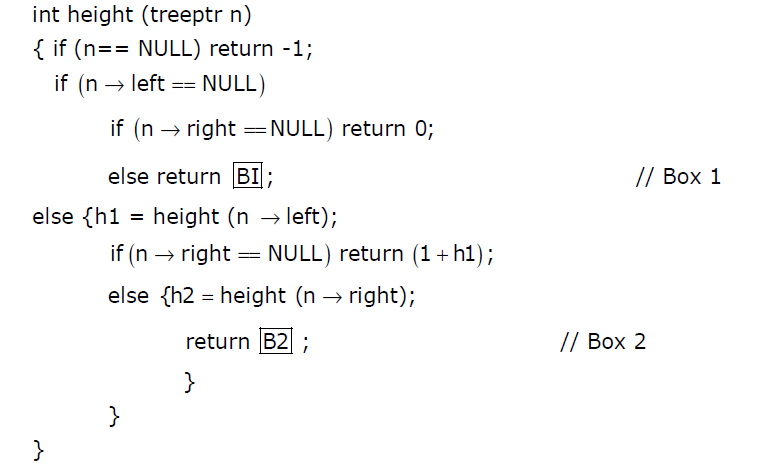
The appropriate expression for the two boxes B1 and B2 are
(A) B1 : (1 + height(n->right)), B2 : (1 + max(h1,h2))
(B) B1 : (height(n->right)), B2 : (1 + max(h1,h2))
(C) B1 : height(n->right), B2 : max(h1,h2)
(D) B1 : (1 + height(n->right)), B2 : max(h1,h2)
48.
What is
the post order traversal of a tree if the preorder traversal is 14 2 1 3 11 10 7 30 40 & in-order
traversal is 1 2 3 14 7 10 11 40 30. 4M
a. 40
30 14 11 10 7 3 2 1
b. 1 2
3 40 30 10 7 11 14
c. 1 3 2
7 10 40 30 11 14
d. None
of these
UNIT III
1.
Which of the following statements is true? 1M
A. A graph can drawn on paper in
only one way.
B. Graph vertices may be linked in any
manner.
C. A graph must have at least one
vertex.
D. A graph must have at least one edge.
2.
A simple graph has no loops. What other property must a simple
graph have? -
-
1M
o A.
It must be directed.
o B.
It must be undirected.
o C.
It must have at least one vertex.
o D. It
must have no multiple edges.
3.
Which graph traversal algorithm uses a queue to keep track of
vertices which need to be processed?
1M
o A. Breadth-first
search.
o B.
Depth-first search.
o Both
o Neither
A nor B
4.
Which graph traversal algorithm uses a stack to keep track of
vertices which need to be processed?
1M
o A.
Breadth-first search.
o B. Depth-first
search.
o Both
o Neither
A nor B
5.
Which graph representation allows the most efficient determination
of the existence of a particular edge in a graph?
1M
o A. An adjacency matrix.
o B. Edge
lists.
o Both
o Neither
A nor B
6.
How many total number of edges present in complete undirected
graph if it has n nodes 1M
o N
o N(n-1)
o N(n-1)/2
o None
of these
7.
How many total number of edges present in complete directed graph
if it has n nodes
1M
o N
o N(n-1)
o N(n-1)/2
o None
of these
8.
The data structure required for breadth first
traversal on a graph is 1M
o Stack
o Queue
o Both
o Tree
9.
The data structure required for Depth first
traversal on a graph is 1M
o Stack
o Queue
o Both
o Tree
10. Suppose
you have a game with 5 coins in a row and each coin can be heads or tails. What
number of vertices might you expect to find in the state graph? 2M
o A. 7
o B.
10
o C.
25
o D. 32
11. Why
is the state graph for tic-tac-toe a directed graph rather than an undirected
graph?
2M
o A. Once a
move is made, it cannot be unmade.
o B.
There is an odd number of vertices.
o C.
There is an odd number of edges.
o D.
There is more than one player in the game.
12. Suppose
you have a directed graph representing all the flights that an airline flies.
What algorithm might be used to find the best sequence of connections from one
city to another?
2M
o A.
Breadth first search.
o B.
Depth first search.
o C. Prims
algorithm
o D. A
shortest-path algorithm.
13. If G
is an directed graph with 20 vertices, how many boolean values will be needed
to represent G using an adjacency matrix? 2M
o A.
20
o B.
40
o C.
200
o D. 400
14. How
many linked lists are used to represent a graph with n nodes and m edges, when
using an adjacency list representation, 2M
o A. m
o B. n
o C. m
+ n
o D.
m*n
15. How
many total nodes will be present if a graph has n nodes and m edges, &
created using an adjacency list representation, 2M
o A. 2n
o B. 2m
o C. m
+ n
o D.
m*n
16. What
is the expected number of operations needed to loop through all the edges
terminating at a particular vertex given an adjacency matrix representation of
the graph? (Assume n vertices are in the graph and m edges terminate at the
desired node.)
2M
o A.
O(m)
o B.
O(n)
o C. O(m²)
o D.
O(n²)
17. Shortest
path algorithm gives minimum spanning tree. 2M
o A
true
o B. False
o C.
Not always
o D.
None of these
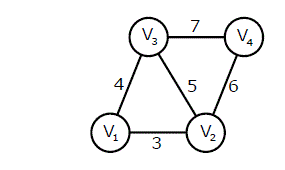
An
undirected graph G(V, E) contains n ( n > 2 ) nodes named v1 , v2 ,….vn. Two
nodes vi , vj are connected if and only if 0 < |i – j| <= 2. Each edge
(vi, vj ) is assigned a weight i + j. A sample graph with n = 4 is shown below.
18. Consider the directed
graph shown in the figure below. There are multiple shortest paths between
vertices S and T. Which one will be reported by Dijkstra’s shortest path
algorithm? Assume that, in any iteration, the shortest path to a vertex v is
updated only when a strictly shorter path to v is discovered.
 |
|||
|
A.
|
SDT
|
B.
|
SBDT
|
|
C.
|
SACDT
|
D.
|
SACET
|
19. What
will be the cost of the minimum spanning tree (MST) of such a graph with n
nodes?
4M
(A) 1/12(11n^2 – 5n)
(B) n^2 – n + 1
(C) 6n – 11
(D) 2n + 1
(A) 1/12(11n^2 – 5n)
(B) n^2 – n + 1
(C) 6n – 11
(D) 2n + 1
20. The
length of the path from v5 to v6 in the MST of previous question with n = 10
is - 4M
(A) 11
(B) 25
(C) 31
(D) 41
(A) 11
(B) 25
(C) 31
(D) 41
21. Which is correct statement with respect to
Shortest path algorithm 1M
A. Always
gives Minimum cost spanning tree
B. Sometimes
gives Minimum cost spanning tree
C. Never
gives Minimum cost spanning tree
D. None
of these.
22. The number of distinct simple graphs with up
to three nodes are
|
A
|
15
|
|
|
|
|
B
|
10
|
|
||||||||||||||||
23.
|
24. Consider the
following graph: 4M

Which
one of the following is NOT the sequence of edges added to the minimum
spanning tree using Kruskal's algorithm?
|
|||
|
A.
|
(b,e)
(e,f) (a,c) (b,c) (f,g) (c,d)
|
B.
|
(b,e)
(e,f) (a,c) (f,g) (b,c) (c,d)
|
|
C.
|
(b,e)
(a,c) (e,f) (b,c) (f,g) (c,d)
|
D.
|
(b,e) (e,f) (b,c) (a,c) (f,g) (c,d)
|
UNIT IV
1.
What is the worst-case time for serial search finding a single
item in an array?
-
1M
o A.
Constant time
o B.
Logarithmic time
o C.
Linear time
o D.
Quadratic time
2.
What is the worst-case time for binary search finding a single
item in an array? -
1M
o A.
Constant time
o B.
Logarithmic time
o C.
Linear time
o D.
Quadratic time
3.
What additional requirement is placed on an array, so that binary
search may be used to locate an entry?
1M
o A.
The array elements must form a heap.
o B.
The array must have at least 2 entries.
o C. The
array must be sorted.
o D.
The array's size must be a power of two.
|
|
4.
What is the best definition of a collision in a hash table? 2M
o A.
Two entries are identical except for their keys.
o B. Two
entries with different data have the exact same key.
o C. Two
entries with different keys have the same exact hash value.
o D.
Two entries with the exact same key have different hash values.
5.
A chained hash table has an array size of 512. What is the maximum
number of entries that can be placed in the table?
2M
o A.
256
o B.
511
o C. 512
o D.
1024
o E.
There is no maximum.
|
|
6.
Suppose you place m items in a hash table with an array size of s.
What is the correct formula for the load factor? 2M
o A. s
+ m
o B. s
- m
o C. m
- s
o D. m
* s
o E. m /
s
7.
Given the following input (4322,
1334, 1471, 9679, 1989, 6171, 6173 and 4199) and the hash function x mod 10,
which of the following statements are true? 2M
i. 9679, 1989, 4199 hash to the same value
ii. 1471, 6171 has to the same value
iii. All elements hash to the same value
iv. Each element hashes to a different value
a)i only
b) ii only
c) i and ii only
d) iii or iv
i. 9679, 1989, 4199 hash to the same value
ii. 1471, 6171 has to the same value
iii. All elements hash to the same value
iv. Each element hashes to a different value
a)i only
b) ii only
c) i and ii only
d) iii or iv
8.
What
is the maximum height of any AVL-tree with 7 nodes? Assume that the height of a
tree with a single node is 0. 2M
o A. 2 b. 3
c. 4 d. 5
9.
The degree sequence of a simple graph is the
sequence of the degrees of the nodes in the graph in decreasing order. Which of
the following sequences can not be the degree sequence of any graph?
2M
|
|||||||
|
A.
|
I
and II
|
B.
|
III
and IV
|
||||
|
C.
|
IV
only
|
D.
|
II and IV
|
||||
10. insert the characters of string K R P C S N Y T J M into a
hash table of size 10.
use the hash function H(x)=(ord(x)-ord('a')+1) mod 10 and linear probing to resolve collisions. which insertions cause collision? 4M
a.j,m
b.j,k
c.n,y
d.t,p
use the hash function H(x)=(ord(x)-ord('a')+1) mod 10 and linear probing to resolve collisions. which insertions cause collision? 4M
a.j,m
b.j,k
c.n,y
d.t,p
11. The keys 12, 18, 13, 2, 3, 23, 5 and 15 are inserted into an
initially empty hash table of length 10 using open addressing with hash
function h(k) = k mod 10 and linear probing. How many average number of
comparisons are required in resultant hash table?
4M
e. 18/8 b.21/8 c. 24/8 d.25/8
12. Consider a hash table of size seven, with starting index
zero, and a hash function (3x + 4) mod 7. Assuming the hash table is initially
empty, which of the following is the contents of the table when the sequence 1,
3, 8, 10 is inserted into the table using closed hashing? Note that ‘_’ denotes
an empty location in the table.
4M
(a) 8, _, _, _, _, _, 10 (b) 1, 8, 10, _, _, _, 3
(c) 1, _, _, _, _, _,3 (d) 1, 10, 8, _, _, _, 3
(a) 8, _, _, _, _, _, 10 (b) 1, 8, 10, _, _, _, 3
(c) 1, _, _, _, _, _,3 (d) 1, 10, 8, _, _, _, 3
13. Draw
a hash table with open addressing and a size of 9. Use the hash function
"k%9". Insert the keys: 5, 29, 20, 0, 27,77,58,49 and 18 into your
table (in that order). –
8M
|
|
14. I
plan to put 1000 items in a hash table, and I want the average number of
accesses in a successful search to be about 2.0. 8M
A. About how big should the array be if
I use open addressing with linear probing? NOTE: For a load factor of A,
the average number of accesses is generally ½(1+1/(1-A)).
B. About how big should the array be if
I use chained hashing? NOTE: For a load factor of A, the average
number of accesses is generally (1+A/2).
|
|
o
15. Which
guideline is NOT suggested from empirical or theoretical studies of hash
tables:
o A.
Hash table size should be the product of two primes.
o B.
Hash table size should be the upper of a pair of twin primes.
o C.
Hash table size should have the form 4K+3 for some K.
o D.
Hash table size should not be too near a power of two.
16. In
an open-address hash table there is a difference between those spots which have
never been used and those spots which have previously been used but no longer
contain an item. Which function has a better implementation because of this
difference?
o A.
insert
o B.
is_present
o C.
remove
o D.
size
o E.
Two or more of the above functions
17. What
kind of initialization needs to be done for an open-address hash table?
o A.
None.
o B.
The key at each array location must be initialized.
o C.
The head pointer of each chain must be set to NULL.
o D.
Both B and C must be carried out.
|
|
18. What
kind of initialization needs to be done for an chained hash table?
o A.
None.
o B.
The key at each array location must be initialized.
o C.
The head pointer of each chain must be set to NULL.
o D.
Both B and C must be carried out.
